



The global ashwagandha market reached $4.2 billion in 2025, driven by unprecedented consumer demand for natural stress relief and adaptogenic supplements. With over 3,500 published studies on Withania somnifera, ashwagandha is one of the most clinically researched herbs in the supplement industry. For brands looking to launch a private label ashwagandha product, understanding the differences between extract types — particularly KSM-66, Sensoril, and standard extracts — is essential for product positioning, efficacy, and regulatory compliance.
Why Ashwagandha Supplements Matter for Your Brand
Ashwagandha has transitioned from a niche herbal supplement to a mainstream wellness product, appearing in mass-market retail chains alongside vitamins and minerals.
Stress and Cortisol Management — Ashwagandha is the most clinically studied adaptogen for stress reduction. Multiple randomized controlled trials show 23-45% reduction in serum cortisol levels with standardized ashwagandha root extract supplementation over 60 days.
Cognitive Function — Studies demonstrate improvements in reaction time, task performance, and memory with ashwagandha supplementation. The cognitive benefits are particularly strong in stressed populations.
Physical Performance — Ashwagandha supplementation shows 12-20% improvements in VO2 max, muscle strength, and recovery in athletic populations, creating crossover appeal for sports nutrition brands.
Sleep Quality — 72% of ashwagandha users report improved sleep quality in clinical studies. The sleep support segment of the ashwagandha market is growing at 14% CAGR, outpacing the overall category.
Key Factors to Consider When OEM Manufacturing Ashwagandha Supplements
What Are the Different Types of Ashwagandha Extracts?
| Extract Type | Withanolide Content | Key Features | Wholesale Cost per kg | Best For |
|---|---|---|---|---|
| KSM-66 (Root Only) | 5% withanolides (minimum) | Water-extracted, full-spectrum root, most clinically studied | $50-80 | Stress, energy, sports performance |
| Sensoril (Root + Leaf) | 8-10% withanolides, 1% withaferin A | Water-ethanol extract, higher potency | $70-120 | Sleep, relaxation, immune support |
| Standard Root Extract (2.5%) | 2.5% withanolides | Entry-level, ethanol or hydro-alcoholic | $25-40 | Budget products, blends |
| Standard Root Extract (5%) | 5% withanolides | Most common in mid-market products | $40-60 | Mid-range private label |
| High-Potency (10%) | 10% withanolides | Concentrated extract, ethanol extraction | $80-150 | Premium products, capsules |
| Whole Root Powder | Natural 0.3-0.5% withanolides | Unconcentrated, organic certification friendly | $10-20 | Bulk powders, organic positioning |
What Is the Difference Between KSM-66 and Sensoril?
| Factor | KSM-66 | Sensoril |
|---|---|---|
| Plant Part Used | Root only | Root and leaf |
| Extraction Method | Water only (milk-based traditional process) | Water and ethanol |
| Withanolide Content | ≥5% withanolides | ≥8% withanolides, ≥1% withaferin A |
| Withaferin A | Below detectable levels | Standardized (higher bioavailability) |
| Clinical Studies | 20+ published studies | 10+ published studies |
| Patented/Trademarked | Yes (Ixoreal Biomed) | Yes (Natreon/NutraGenesis) |
| Primary Use | Stress, energy, sports performance, cognition | Sleep, stress, immune, relaxation |
| Recommended Dose | 300-600 mg twice daily | 125-250 mg twice daily |
| Retail Price Positioning | Premium stress/energy | Ultra-premium sleep/relaxation |
What Quality Tests Are Required for Ashwagandha Supplements?
- Withanolide Content by HPLC — Verifies the concentration of bioactive withanolide glycosides (primarily withaferin A, withanolide A, withanoside IV)
- Heavy Metals — Limits: As < 1 ppm, Cd < 0.3 ppm, Pb < 2 ppm, Hg < 0.1 ppm
- Microbial Testing — Total aerobic plate count, yeast and mold, E. coli, Salmonella, S. aureus
- Pesticide Residues — Testing for 70+ pesticides per pharmacopoeia standards
- Botanical Identity — Macroscopic and microscopic identification or HPTLC fingerprinting
- Loss on Drying — Moisture content < 5% for extracts, < 8% for whole powder
- Particle Size — % passing through specified mesh screen for encapsulation consistency
What Is the MOQ for Ashwagandha Supplements?
| Dosage Form | Extract Type | Typical MOQ | Lead Time |
|---|---|---|---|
| Capsules (standard extract) | 5% withanolides | 10,000-50,000 capsules | 3-5 weeks |
| Capsules (KSM-66 or Sensoril) | Proprietary extract | 10,000-30,000 capsules | 4-6 weeks |
| Tablets | Standard or high-potency | 50,000-100,000 tablets | 5-7 weeks |
| Bulk Powder | Any extract type | 25-200 kg | 2-4 weeks |
| Gummies | Ashwagandha-infused | 10,000-30,000 gummies | 6-8 weeks |
| Liquid Tincture | Liquid extract | 500-2,000 bottles | 4-6 weeks |
SREKE offers ashwagandha OEM manufacturing with flexible MOQ starting from 10,000 capsules, including access to patented KSM-66 and Sensoril extracts with full certification and traceability.
The Ashwagandha Supplement Manufacturing Process
Step 1: Raw Material Sourcing — Ashwagandha root is sourced from certified organic farms in India (the primary growing region). Each lot is verified for botanical identity, withanolide content, and contaminants.
Step 2: Extraction — For standardized extracts, the dried root is extracted using water (for KSM-66) or water-ethanol (for Sensoril) at controlled temperatures (60-80°C). The extract is filtered and concentrated under vacuum.
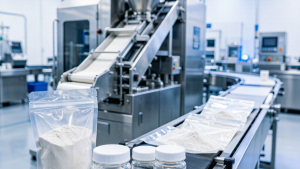
Step 3: Drying and Milling — The concentrated extract is spray-dried or vacuum-dried to a powder, then milled to uniform particle size (60-100 mesh). Excipients may be added for flow and consistency.
Step 4: Blending — The extract is blended with excipients (microcrystalline cellulose, silicon dioxide, magnesium stearate) in V-blenders or ribbon blenders for 10-30 minutes to achieve uniform distribution.
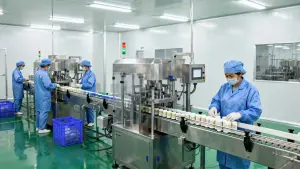
Step 5: Encapsulation — The blended powder is filled into vegetarian capsules (HPMC or pullulan) or gelatin capsules on automatic encapsulation machines. Capsule sizes from size 00 (600-750 mg fill) to size 1 (400-500 mg fill) are common.
Step 6: Quality Control — Finished products undergo potency testing (withanolide content by HPLC), content uniformity, microbial limits, dissolution testing, and packaging integrity checks.
KSM-66 vs Sensoril vs Standard Extract — Which Is Right for Your Brand?
| Factor | KSM-66 (5% Root Extract) | Sensoril (8% Root+Leaf) | Standard (5% Root Extract) |
|---|---|---|---|
| Clinical Trial Support | 20+ published studies | 10+ published studies | 5+ published studies |
| Active Dose | 300-600 mg | 125-250 mg | 300-500 mg |
| Withaferin A Content | Below detectable | Standardized (1%) | Variable (<0.1%) |
| Consumer Recognition | Strong (branded ingredient) | Strong (branded ingredient) | Low (generic) |
| Wholesale Cost per Capsule | $0.04-0.08 | $0.06-0.12 | $0.02-0.04 |
| Best For | Stress, energy, sports | Sleep, deep relaxation | Budget, blends, capsules |
Frequently Asked Questions
What dosage of ashwagandha should I use in my product?
For KSM-66, the clinically effective dose is 300-600 mg taken twice daily (total 600-1,200 mg). For Sensoril, 125-250 mg twice daily (total 250-500 mg). For standard 5% withanolide extracts, 300-500 mg daily. Always base your dosage on the specific clinical studies for the extract type you choose.
Can ashwagandha be combined with other ingredients?
Yes, ashwagandha blends well with other adaptogens (rhodiola, holy basil, ashwagandha), with magnesium and L-theanine for sleep formulas, and with shoden or other adaptogens for stress blends. Popular combinations include ashwagandha + magnesium (sleep), ashwagandha + rhodiola (energy), and ashwagandha + L-theanine (calm focus).
Is ashwagandha safe for long-term use?
Ashwagandha has a strong safety profile and is generally recognized as safe for long-term use at recommended doses. Clinical studies have used ashwagandha continuously for up to 12 months without significant adverse effects. As with any supplement, consult with healthcare providers for customers with specific medical conditions.
How long does it take to develop a private label ashwagandha product?
For standard extracts, development takes 4-6 weeks. For branded extracts like KSM-66 or Sensoril requiring supply chain coordination, 6-8 weeks is typical. Custom formulations with multiple ingredients may require 8-12 weeks.
Does SREKE offer KSM-66 and Sensoril certified ashwagandha products?
Yes. SREKE manufactures ashwagandha supplements using KSM-66 and Sensoril branded extracts with full certification and traceability from the patent holders. We also offer standard and high-potency extracts for brands seeking cost-optimized or custom formulations.
How to Get Started with SREKE
SREKE provides comprehensive ashwagandha OEM manufacturing services with access to branded extracts (KSM-66, Sensoril), standard extracts, and custom formulations across all dosage forms including capsules, tablets, gummies, and powders.
Contact our team to discuss your ashwagandha supplement project. We will help you select the optimal extract type, dosage form, and formulation for your target market and budget.