



The global liquid supplement market reached $12.8 billion in 2025, driven by consumer preference for easy-to-consume formats with faster absorption rates. For brands looking to launch or expand their product lines, liquid supplements offer a distinct advantage — bioavailability studies show liquid formulations can achieve up to 40% higher absorption compared to solid dosage forms. Understanding the manufacturing process, packaging requirements, and regulatory landscape is essential to successfully bring a liquid supplement to market.
Why Liquid Supplements Matter for Your Brand
Consumers are shifting away from traditional pills and capsules toward liquid formats that feel more modern and effective. Market data from 2025 shows liquid supplements growing at 7.2% CAGR, outpacing the overall supplement market. Key drivers include:
Higher Consumer Preference — 62% of supplement users report difficulty swallowing pills, making liquids a natural alternative that expands your addressable market. Elderly consumers, children, and fitness enthusiasts are particularly drawn to liquid formats.
Faster Onset of Action — Liquid supplements bypass the disintegration and dissolution steps required by solid forms. For active ingredients like electrolytes, B vitamins, and amino acids, liquid delivery means faster systemic availability.
Product Differentiation — The liquid supplement space is less crowded than capsules or tablets, offering brands an opportunity to stand out on retail shelves. Unique flavor profiles and functional formulations create strong brand differentiation.
Higher Perceived Value — Liquid supplements often command premium pricing. The average retail price per serving for liquid supplements is 25-35% higher than equivalent capsule products, offering better margins for brand owners.
Key Factors to Consider When Manufacturing Liquid Supplements
What Types of Liquid Supplements Can Be Manufactured?
Liquid supplements come in several formats, each with distinct manufacturing requirements:
| Format | Description | Typical Applications | Average Fill Volume |
|---|---|---|---|
| Ready-to-Drink (RTD) | Pre-mixed, shelf-stable liquids | Energy drinks, protein shakes, electrolytes | 250-500 ml |
| Liquid Shot Concentrates | High-dose, small volume | Vitamin D, immune support, energy boost | 30-60 ml |
| Liquid Tinctures/Extracts | Alcohol or glycerin-based | Herbal supplements, CBD, adaptogens | 15-60 ml |
| Liquid Syrups | Thick, sweetened base | Children's vitamins, cough/immune | 100-250 ml |
| Suspensions | Particles suspended in liquid | Minerals like calcium, magnesium | 200-500 ml |
| Emulsions | Oil-in-water or water-in-oil | Omega-3, CoQ10, fat-soluble vitamins | 100-300 ml |
What Are the Key Formulation Challenges for Liquid Supplements?
Formulating liquid supplements presents unique technical challenges that differ from solid dosage forms:
Solubility and Stability — Many active ingredients have poor water solubility. Formulation scientists must use techniques like micronization, emulsification, or cyclodextrin complexation to ensure ingredients remain evenly dispersed throughout the product's shelf life.
Flavor Masking — Vitamins and minerals often have bitter or metallic tastes. Effective flavor masking requires a combination of natural and artificial flavors, sweeteners (stevia, monk fruit, allulose), and bitterness blockers. On average, flavor development adds 4-8 weeks to the formulation timeline.
Preservation and Shelf Life — Liquid supplements are susceptible to microbial growth. Manufacturers typically achieve 18-24 month shelf life through a combination of hot-fill processing (185-205°F for 15-30 seconds), pH adjustment (typically maintaining pH below 4.5), preservative systems (potassium sorbate, sodium benzoate, natural alternatives), and clean room filling environments (ISO Class 8 or better).
Ingredient Interactions — Multiple active ingredients in liquid form can interact over time, leading to degradation or precipitation. Accelerated stability testing (40°C/75% RH for 3 months) is standard before scale-up.
What Packaging Options Are Available for Liquid Supplements?
Packaging for liquid supplements requires careful consideration of material compatibility, barrier properties, and consumer convenience:
| Package Type | Material | Volume Range | Best For | Estimated Cost per Unit |
|---|---|---|---|---|
| Glass Bottles | Amber/clear glass | 30-500 ml | Premium products, essential oils, tinctures | $0.50-1.50 |
| PET Bottles | Plastic #1 | 100-1000 ml | RTD drinks, shots, daily supplements | $0.15-0.40 |
| HDPE Bottles | Plastic #2 | 200-500 ml | Suspensions, bulk liquids | $0.20-0.50 |
| Stick Packs | Laminated foil | 10-30 ml | On-the-go shots, travel | $0.10-0.25 |
| Glass Ampoules | Borosilicate glass | 5-20 ml | Single-dose, premium serums | $0.80-2.00 |
| Aluminum Cans | Aluminum alloy | 250-500 ml | RTD energy, sports drinks | $0.25-0.60 |
Closure types include screw caps (child-resistant and standard), dropper inserts, pump dispensers, and foil seals for tamper evidence.
What Is the MOQ for Liquid Supplement Manufacturing?
MOQ varies significantly by manufacturing complexity and packaging type:
- Standard liquid fills (non-sterile): 1,000-5,000 units per SKU
- Aseptic/sterile fills: 5,000-20,000 units per SKU
- Hot-fill processing: 3,000-10,000 units per SKU
- Bulk liquid manufacturing (without bottling): 100-500 liters per batch
- Trial/R&D batches: 50-200 units for stability testing
SREKE offers flexible MOQ options starting from 1,000 units for standard liquid formulations, with scaled pricing as volumes increase to 10,000+, 50,000+, and 100,000+ units.
What Certifications Should a Liquid Supplement Manufacturer Have?
Essential certifications for liquid supplement contract manufacturers:
- cGMP Certification (21 CFR Part 111) — Mandatory for US-market products
- FDA Registration — Facility registration with the US FDA
- ISO 22000 or FSSC 22000 — Food safety management systems
- Kosher Certification — Required for kosher-labeled products
- Halal Certification — Required for halal-labeled products
- Organic Certification (USDA, EU Organic) — For organic formulations
- Non-GMO Project Verified — Increasingly requested by retailers
- NSF International Certification — Especially important for sports nutrition products
The Liquid Supplement Manufacturing Process: Step by Step
Step 1: Formulation Development — The process begins with translating your product concept into a viable formula. R&D scientists evaluate ingredient compatibility, stability, and bioavailability. This phase typically takes 4-8 weeks and includes initial benchtop prototypes.
Step 2: Flavor Optimization and Sensory Testing — Once a base formulation is stable, the flavor development team creates multiple flavor iterations. These undergo sensory panels with 20-50 participants to identify the optimal flavor profile. This stage takes 2-4 weeks.
Step 3: Stability Testing — The final formulation undergoes accelerated stability testing at 40°C/75% RH for 3 months (equivalent to 18-24 months ambient storage). Microbial testing, pH monitoring, and active ingredient potency assays are conducted at multiple time points.
Step 4: Scale-Up and Pilot Batch — Once stability is confirmed, the formula is scaled from benchtop (1-5 liters) to pilot scale (50-200 liters). This identifies any processing challenges including mixing times, heating/cooling rates, and filling line adjustments.
Step 5: Commercial Production — Upon successful pilot batch, commercial production begins. Raw materials are verified through incoming QA testing, and the batch is manufactured in stainless steel processing tanks. In-process quality checks occur at every stage.
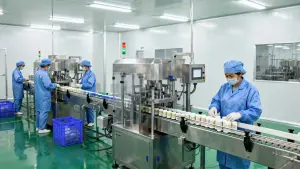
Step 6: Filling and Packaging — The liquid is filled into primary containers on automated filling lines running at 30-150 bottles per minute depending on format. Filled containers are capped, labeled, induction-sealed, and packed into cases.
Step 7: Final QC and Shipment — Finished products undergo final QC testing including identity, potency, microbial limits, and package integrity. Batches that pass are released for shipment. Lead time from production start to shipment is typically 3-5 weeks.
Liquid Supplements vs Other Dosage Forms — Which One Is Right for Your Brand?
| Factor | Liquid Supplements | Softgels | Tablets | Powders |
|---|---|---|---|---|
| Absorption Rate | Fastest (15-30 min) | Moderate (30-60 min) | Slow (30-120 min) | Fast (20-40 min) |
| Bioavailability | 30-40% higher than tablets | Moderate | Baseline | High |
| Serving Convenience | Ready-to-drink | Easy to swallow | May be difficult | Needs mixing |
| Taste/Mouthfeel | Requires flavoring | Tasteless | Tasteless | Varies |
| Shelf Life | 18-24 months | 24-36 months | 24-36 months | 18-24 months |
| Packaging Weight | Heavy (liquid) | Light | Light | Light |
| Per-Unit Cost | Higher | Moderate | Low | Moderate |
| Best For | Daily wellness, sports, children | Oils, single ingredients | High-dose compounds | On-the-go, bulk |
| Customization Options | High (flavors, formats) | Moderate | Moderate | High |
Frequently Asked Questions
What is the typical shelf life of a liquid supplement?
Most liquid supplements achieve 18-24 months shelf life when properly formulated with appropriate preservative systems and packaged in light-protective containers. Refrigerated products may have shorter shelf lives of 6-12 months.
Do liquid supplements need to be refrigerated?
Not necessarily. Shelf-stable liquid supplements are formulated to remain stable at ambient temperatures. However, products without preservatives (clean label), certain probiotics, and refrigerated-only formulations require cold chain storage from manufacturing to retail.
How long does it take to develop a new liquid supplement?
The full timeline from concept to finished product typically takes 12-20 weeks: formulation development (4-8 weeks), stability testing (8-12 weeks, can run in parallel with packaging), packaging sourcing (4-6 weeks), and production (3-5 weeks).
What is the minimum order quantity for liquid supplements?
Standard MOQ for liquid supplement contract manufacturing ranges from 1,000 to 5,000 units per SKU. SREKE offers MOQ as low as 1,000 units for standard formulations, with reduced per-unit pricing at higher volumes.
Can I manufacture flavored liquid supplements?
Yes. Flavor customization is one of the key advantages of liquid supplements. Manufacturers offer a wide range of natural and artificial flavors, and most provide dedicated flavor development services including sensory panel testing.
What certifications do I need for selling liquid supplements internationally?
Requirements vary by target market. The US requires cGMP compliance (21 CFR Part 111) and FDA facility registration. The EU requires compliance with EU Regulation 1925/2006 and Novel Food regulation for new ingredients. Many retailers also require third-party certifications like Non-GMO, Organic, or Kosher.
How do I ensure my liquid supplement tastes good?
Partner with a manufacturer that has dedicated flavor R&D capabilities. Request flavor sampling panels (most offer 5-10 flavor options per base formulation). Consider sweetener type and level, and test with your target demographic. Natural flavors and alternative sweeteners (stevia, monk fruit) are increasingly preferred by consumers.
How to Get Started with SREKE
SREKE offers comprehensive liquid supplement contract manufacturing services with full R&D support, flexible MOQ from 1,000 units, and cGMP-certified production facilities. Our team handles every step from formulation development to final packaging, ensuring your liquid supplement meets regulatory requirements for your target markets.
Contact us to discuss your liquid supplement project. Share your product concept, target market, and volume requirements, and we will provide a detailed proposal including formulation options, packaging recommendations, and pricing.